Negative Self-Talk: How to Quiet Your Inner Critic (Without Faking Positivity)
Your inner critic isn't telling the whole truth. Learn 5 CBT-based ways to quiet negative self-talk, plus a 5-minute reframe, no forced positivity needed.
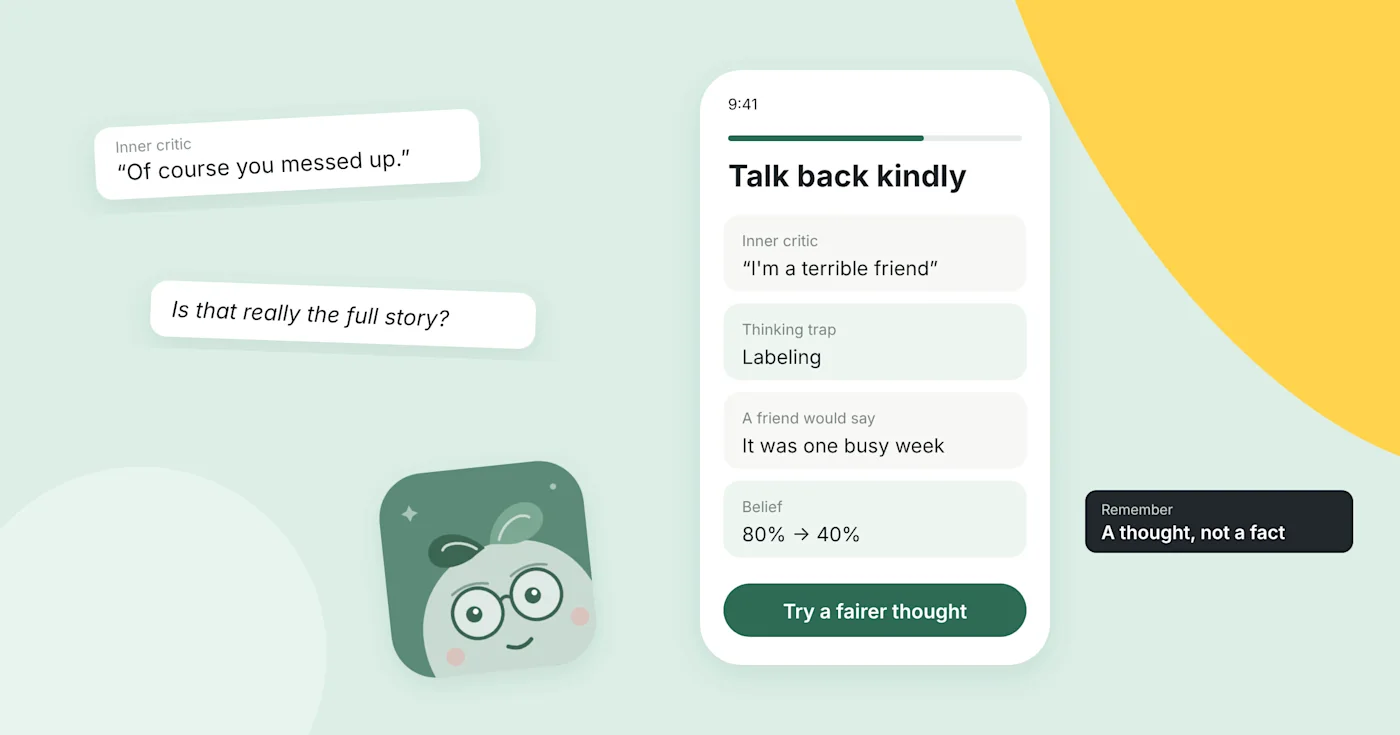
"You're so stupid." "Of course you messed that up." "Everyone else has it together except you." If your inner voice talks to you like this, you're not alone, and it doesn't mean those words are true.
Negative self-talk is the harsh running commentary you aim at yourself, often without noticing. The good news: you don't have to drown it out with forced positivity. You can learn to catch it, check it, and answer it more fairly. This guide shows you how, with a five-minute exercise you can try today.
What is negative self-talk?
Negative self-talk is the critical voice in your head that judges, blames, or predicts the worst about you. It often sounds like a strict coach who never says anything nice. It shows up after a mistake, before something scary, or late at night when you're tired.
In CBT (cognitive behavioral therapy), these are called automatic negative thoughts. They pop up fast and feel like facts, but they're really just thoughts, and thoughts can be checked.
Common types of negative self-talk
Most harsh self-talk follows a few familiar patterns, known as thinking traps or cognitive distortions. Spotting the pattern is the first step to loosening it.
Labeling: "I'm such an idiot." One mistake becomes your whole identity.
Catastrophizing: "This is going to be a disaster." You jump straight to the worst outcome. Read more about catastrophizing.
Mind reading: "They think I'm boring." You assume you know what others think. See mind reading.
Should statements: "I should be further along by now." Rigid rules that leave no room for being human.
Discounting the positive: "That went well, but it was just luck." Good things don't count; bad things do.
Why being kinder to yourself isn't "going soft"
Many people worry that if they stop criticizing themselves, they'll stop trying. Research suggests the opposite pattern. A 2012 meta-analysis of 14 studies found that people with higher self-compassion tended to report lower levels of depression, anxiety, and stress (MacBeth & Gumley, Clinical Psychology Review). That's a link, not proof of cause, but it challenges the idea that harshness keeps you on track.
Being kind to yourself isn't about pretending everything is fine. It's about speaking to yourself the way a good friend or mentor would: honestly, but without cruelty.
5 ways to quiet negative self-talk
1. Notice it and name it
You can't change a voice you don't hear. For a day, just notice when the critic shows up. When it does, label it: "That's a thought, not a fact." Neuropsychologist Judy Ho recommends this kind of labeling to create a little distance from the thought (NBC/CNBC).
2. Talk to yourself by name
It sounds odd, but it works for many people. In a set of seven studies, people who talked to themselves using their own name or "you" instead of "I" felt less distressed and performed better under stress, like before giving a speech (Kross et al., 2014). Try "Sarah, you've handled hard meetings before" instead of "I can't do this."
3. Check the evidence
Ask: What would a camera actually have recorded? What's the evidence for this thought, and against it? This is the core of Socratic questioning, and it helps you separate what happened from the story your critic told about it.
4. Use "yes, and" balance
You don't have to deny the hard part. Try: "Yes, I missed that deadline, and I also caught two big errors on the project this month." Both things are true. Your critic only wants you to see the first one.
5. Ask what you'd say to a friend
If a friend said "I'm useless" after a rough day, you wouldn't agree. You'd remind them of the full picture. Give yourself the same courtesy. This simple question is one of the fastest ways into cognitive reframing.
Try it now: a 5-minute self-talk reframe
Grab a note or open your phone. Here's a worked example.
The thought: "I forgot my friend's birthday. I'm a terrible friend." Belief: 80%.
Step 1: Name the thinking trap. This is labeling: one missed date turned into "terrible friend."
Step 2: Check the evidence. Against: you've shown up for this friend many times, you helped them move last year, you text often. For: you forgot this one date.
Step 3: Rewrite it the way a friend would. "I forgot a birthday during a busy week. That's a mistake, not who I am. I can message them today and make it up to them."
Step 4: Re-rate your belief in the original thought. If it dropped from 80% to 40%, that's real progress. For more practice with this format, try our three-minute thought record.
If you'd like a guided way to practise this, Miranote walks you through each step and helps you spot the thinking trap behind a thought.
When negative self-talk gets louder
Harsh self-talk often spikes when you're tired, stressed, or overthinking, especially at night or after social situations. If it's part of a bigger spiral, our guide on how to stop overthinking can help.
When to get extra support
Everyone is hard on themselves sometimes. But if your inner critic is relentless, has been loud for weeks, or is affecting your sleep, work, relationships, or how you feel about yourself overall, it's worth talking to a doctor or licensed therapist. CBT with a trained professional can help you work on these patterns in depth.
If your self-talk ever turns to thoughts of harming yourself or not wanting to be here, please reach out right away. In the US you can call or text 988. In the UK, Samaritans are available on 116 123. Elsewhere, call your local emergency number.
Your inner voice can learn a new tone
Your critic learned its script somewhere, and scripts can be rewritten. You won't change it overnight, and that's okay. Each time you catch a harsh thought and answer it fairly, you're practising a kinder voice. Miranote can help you practise, one thought at a time.
Questions about this
What causes negative self-talk?
It can come from many places: past criticism, high pressure, perfectionism, stress, or simply being tired. Over time, harsh thoughts can become a habit that runs on autopilot. The good news is that habits can change. Noticing and gently questioning those thoughts is the first step.
Is negative self-talk a sign of depression?
Not on its own. Most people have negative self-talk sometimes. But if it's constant, comes with low mood that lasts for weeks, or makes daily life hard, it's a good idea to talk to a doctor or therapist, who can help you understand what's going on.
How do I stop negative self-talk fast?
In the moment, try labeling it ("that's a thought, not a fact"), then ask one question: "What would I tell a friend?" Talking to yourself by name instead of "I" can also help create distance. Longer term, regular practice with thought records builds the habit.
Is positive self-talk the same as reframing?
Not quite. Positive self-talk can sometimes mean repeating upbeat phrases you don't believe. Reframing means replacing a distorted thought with a more accurate, balanced one. A good reframe can still admit something is hard, which is why it tends to feel more believable.
Can an app help with negative self-talk?
A self-help app can give you a structured way to catch and reframe harsh thoughts, which makes it easier to practise regularly. It's not a replacement for therapy, but it can be a helpful tool between harder moments or alongside professional support.
Written by
Content writer
Emily Carter writes for MiraNote about everyday CBT skills, thinking traps, and calm, practical ways to untangle a hard thought.
Written and reviewed under our editorial guidelines.
More from the blog
All posts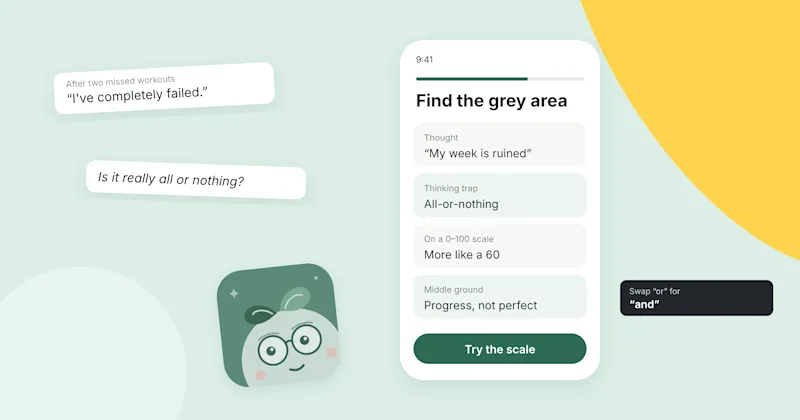
All-or-Nothing Thinking: Examples and How to Find the Middle Ground
One mistake doesn't mean you failed. See real all-or-nothing thinking examples, why your brain thinks in extremes, and 4 CBT steps to find the middle ground.
Catastrophizing: What It Is and How to Stop Expecting the Worst
Does your mind jump straight to the worst case? Learn what catastrophizing is, why it happens, and a simple 5-step CBT technique to stop it.
Overthinking at Work: 5 Ways to Stop Second-Guessing Yourself
Rereading emails, replaying meetings, dreading "can we chat?" Here are 5 CBT-based ways to stop overthinking at work and finally switch off.