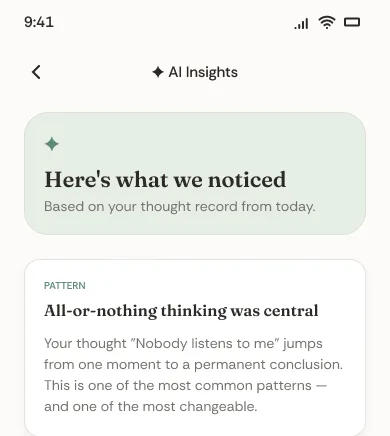
Capture
Write the situation, the thought that showed up, and how strongly you feel it.
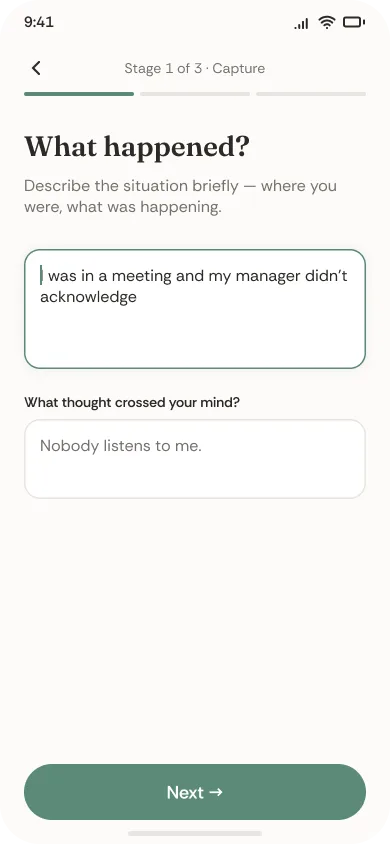
MiraNote walks you through a thought record in three short stages: catch the thought, find the pattern, write a kinder version.


One awkward pause in a meeting and the sentence is already there. It feels like a fact. It is not one.
They must think I'm incompetent.
A thought record, one screen at a time.
Write the situation, the thought that showed up, and how strongly you feel it.
Pick the patterns that fit, then weigh the evidence for and against the thought.
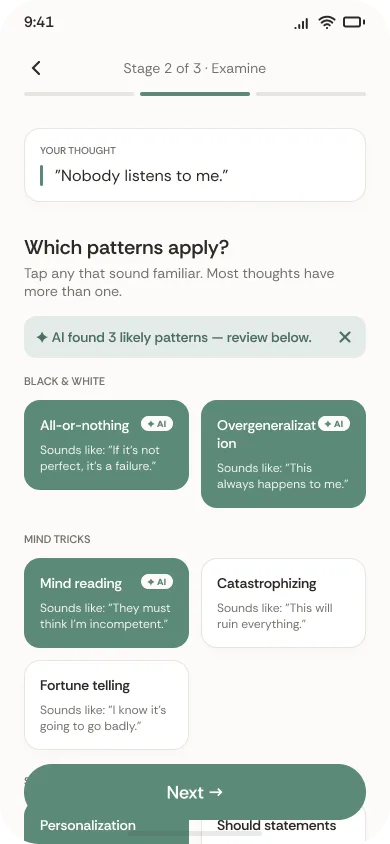
Write the balanced version and rate the feeling again to see what shifted.
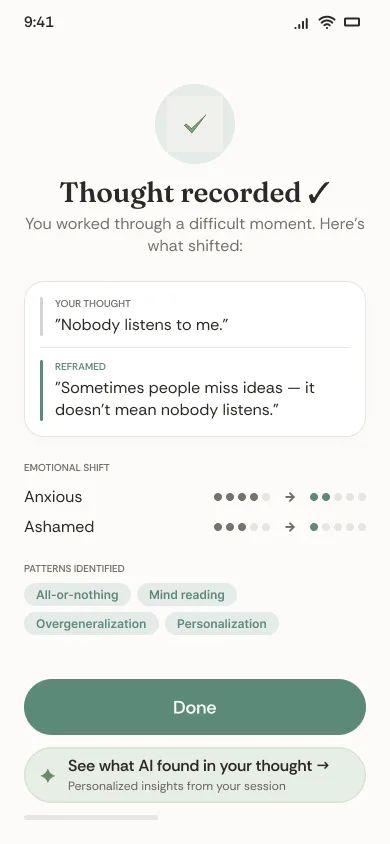
MiraNote names the pattern so you can see the thought for what it is. Five groups, tap any of them.
Thinking in absolutes, where one slip or one bad moment defines the whole picture.
Seeing things in two categories only, with no middle ground.
Sounds like If it's not perfect, it's a failure.
Treating one event as proof of a never-ending pattern.
Sounds like This always happens to me.
Dwelling on a single negative detail until it colours everything.
Sounds like I only focus on what went wrong.
Explaining away good outcomes so they never add up.
Sounds like That went well, but it doesn't count.
Filling gaps with guesses about what others think or what will happen, then treating the guess as fact.
Assuming you know what someone else is thinking, without evidence.
Sounds like They must think I'm incompetent.
Predicting a bad outcome and treating the prediction as settled.
Sounds like I know it's going to go badly.
Expecting the worst possible outcome from a setback.
Sounds like This will ruin everything.
Reaching a verdict before the facts are in.
Sounds like I already know how this will end.
Turning outcomes into verdicts about you, or about everyone else.
Taking responsibility for things that weren't in your control.
Sounds like It's all my fault.
Turning a single mistake into a permanent identity.
Sounds like I'm just a failure.
Holding yourself to rigid rules and punishing every miss.
Sounds like I should have known better.
Placing all responsibility on others so nothing is yours to change.
Sounds like It's everyone else's fault.
Letting the size of a feeling decide the size of the truth.
Treating a feeling as evidence that something is true.
Sounds like I feel stupid, so I must be.
Blowing a problem far out of proportion.
Sounds like This tiny mistake is a disaster.
Shrinking your strengths and wins until they seem not to matter.
Sounds like My success was just luck.
Measuring yourself against everyone else, or holding yourself responsible for things you cannot steer.
Measuring yourself against a polished version of other people.
Sounds like Everyone else has it together but me.
Making your worth depend on other people's approval.
Sounds like I need everyone to like me.
Treating being wrong as unacceptable, whatever the cost.
Sounds like I can't be wrong about this.
Believing you control, or must control, other people's feelings.
Sounds like I'm responsible for how everyone feels.
Mira Says
Mira reads your thought and offers an optional insight. You decide what fits.
No. MiraNote is a self-help tool built around the thought-record structure used in cognitive behavioural therapy (CBT). It can sit alongside therapy, and many people use it to bring examined thoughts to their next session, but it is not a clinical service.
No. Positive thinking tries to replace a bad thought with a good one. Cognitive reframing tries to replace a distorted thought with a more accurate one. The balanced thought is often more hopeful, but it still acknowledges what's hard. "This is a tough week, and I've gotten through tough weeks before" is a reframe. "Everything is great" isn't, especially if part of you doesn't believe it.
A thought record is a short CBT exercise. You write down a situation, the automatic thought it triggered, and how strongly you felt it. Then you look at the evidence and write a more balanced version. In MiraNote this takes three stages and about three minutes.
Two optional things. While you pick patterns, Mira can suggest which of the nineteen distortions fit the thought you wrote. After a record, Mira Says explains the pattern, how to get past it, and offers an alternative thought for your exact situation. You always decide what fits.
Your thought records are stored in your own account on Google Firebase, encrypted in transit, and never sold or shared with other third parties. You can delete your account and every record from inside the app at any time.
iPhone running iOS 15 or later and Android phones running Android 8.0 or later. Sign in with email, Google, or Apple, and your entries sync across your devices.
Free to download on iPhone and Android.