Cognitive Reframing: What It Is and How to Do It
A harsh thought isn't always the whole story. Learn how cognitive reframing works, with 5 simple steps, real examples, and a 5-minute exercise.
Cognitive Reframing: What It Is and How to Do It (With Real Examples)
If one thought has been stuck on repeat since that meeting, that text, or that mistake, you're not doing anything wrong. When we're stressed, minds reach for the harshest explanation first.
Cognitive reframing is a way to loosen that grip. You catch an upsetting thought, check whether it's the whole story, and find a fairer way to see the situation. Below, you'll learn what reframing is, why it works, and exactly how to do it, with real examples and a five-minute exercise you can try tonight.
What is cognitive reframing?
Cognitive reframing is a CBT skill for changing how you interpret a situation, not the situation itself. You notice an automatic negative thought, check it against the facts, and replace it with a more balanced, realistic one. The goal isn't to force yourself to feel happy. It's to see things more accurately, so your feelings match what's really happening.
Think of it like a photo. The same picture looks different depending on how you crop it. Zoom in on one awkward moment and it fills the whole frame. Zoom out, and you can see everything else that happened around it.
The American Psychological Association describes reframing as looking at a problem from a different angle. In therapy, it's usually called cognitive restructuring. Researchers who study emotions call the same process cognitive reappraisal. The names differ, but the core idea is the same.
Reframing is not the same as positive thinking
This is where a lot of people get stuck, so let's be clear. Reframing doesn't ask you to pretend a bad thing is good, or to swap "I failed" for "I'm amazing." Forced positivity tends to bounce right off, because part of you knows it isn't true.
A good reframe is balanced. It keeps the hard parts that are real and drops the parts your worry added. "I made a mistake on the report, and I can fix it" is a reframe. "Everything is perfect!" is not.
Why reframing works: your thoughts sit between what happens and how you feel
In the 1960s, psychiatrist Aaron Beck noticed that his patients had quick negative thoughts that seemed to pop up on their own. He called them "automatic thoughts." He also found that how people interpreted a situation shaped their reaction more than the situation itself. That idea, called the cognitive model, became the foundation of cognitive behavioral therapy (CBT).
Here's how it looks in real life. Two people get the same message from their boss: "Can we talk tomorrow?"
One thinks, "I'm getting fired." Their chest tightens, and they barely sleep. The other thinks, "It's probably about the new project." They feel a little curious and go to bed.
It's the same message with a different thought, and it leads to a very different night.
Automatic thoughts aren't a sign that something is wrong with you. Everyone has them. They're the brain's shortcut for making sense of things quickly.
The trouble is that under stress, those shortcuts often run through thinking traps, which psychologists call cognitive distortions. These include jumping to the worst case, assuming you know what others think, or treating one bad moment as proof of something permanent.
Reframing works because it slows that shortcut down. When you check a thought instead of simply believing it, the feeling attached to it often softens. CBT is built around this skill, and it is backed by more than 2,000 outcome studies, according to the Beck Institute.
How to reframe negative thoughts in 5 steps
You don't need to do this perfectly. The NHS teaches a simple version of reframing unhelpful thoughts: catch the thought, check it, then change it. The five steps below break that down a little further, so you know what to do at each point.
Step 1: Pause and name the feeling
Start with the feeling, not the thought. Are you anxious? Ashamed? Hurt? Angry? Then rate how strong it is, from 0 to 10.
This does two things. Naming a feeling puts a little space between you and it. The rating also gives you something to compare against later, so you can see whether anything shifted.
Step 2: Catch the exact thought
Ask yourself: What was going through my mind just before I felt this way? This simple question is how CBT therapists help people find their automatic thoughts.
Write the thought down in the exact words your mind used, even if they sound harsh or dramatic. "Nobody listens to me" is more useful than "I felt a bit ignored." The raw version is the one driving the feeling.
You don't have to reframe every passing thought. Beck taught that the thoughts worth working on are the ones that bring painful feelings with them. Start there.
Step 3: Spot the thinking trap
Look at the thought and ask: Does this fit a familiar pattern? Some of the most common thinking traps are:
Catastrophizing: jumping to the worst possible outcome ("I'll lose my job over this").
Mind reading: assuming you know what someone else is thinking ("She thinks I'm annoying").
All-or-nothing thinking: seeing things as total success or total failure ("If it's not perfect, it's worthless").
Overgeneralization: treating one event as a never-ending pattern ("This always happens to me").
Personalization: blaming yourself for things that aren't fully about you ("He's quiet because I did something wrong").
Naming the trap matters more than it sounds. Once you can say, "Oh, that's mind reading," the thought starts to feel like a habit of your brain rather than a fact about the world. You can explore the full list in our guide to [cognitive distortions]([LINK: cognitive-distortions]).
Step 4: Question the thought
Now look at the thought the way a fair, curious friend would. You're not trying to argue yourself out of it. You're just checking. These questions help:
What's the evidence that this thought is true? What's the evidence against it?
Is there another way to explain what happened?
What would I say to a friend who had this exact thought?
If the worst did happen, how would I cope?
Will this matter in a week? In a year?
Pick two or three; you don't need all of them. This gentle style of questioning is called [Socratic questioning]([LINK: socratic-questioning]). If your mind keeps racing to the worst outcome, the "how would I cope?" question is the heart of a technique called [decatastrophizing]([LINK: decatastrophizing]).
Step 5: Write a balanced thought, then re-rate your feeling
Using what you found, write a new thought that feels fairer and is still true. It should include the real parts of the situation, not skip past them. A useful test is whether you'd still believe it if you read it tomorrow morning.
Then go back to the feeling from Step 1 and rate it again. Don't expect a zero. A drop from 8 to 5 is a real shift, and that's what progress with reframing usually looks like.
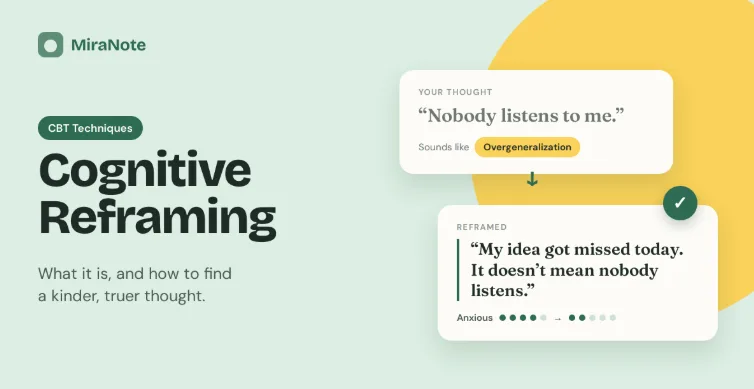
A worked example: "Nobody listens to me"
Let's walk through a full reframe, using a situation many people know too well.
The situation: You're in a team meeting and you share an idea. Your manager nods, says nothing, and moves on. Twenty minutes later, a coworker suggests something similar, and your manager says, "Great idea."
Step 1, the feeling: Anxious (8/10). Ashamed (7/10).
Step 2, the thought: "Nobody listens to me. My ideas never matter."
Step 3, the thinking traps:
Overgeneralization: one meeting has turned into "nobody" and "never."
Mind reading: you're assuming you know why your manager moved on.
All-or-nothing thinking: either you're heard every time, or you don't matter at all.
Personalization: you're treating a rushed moment in a busy meeting as a verdict on you.
Step 4, questioning the thought:
Evidence for: My manager didn't respond to my idea today. That really happened, and it stung.
Evidence against: Last month she asked me to lead the client update. Last week, two people messaged me after a meeting to agree with a point I made.
Other explanations: She may have been thinking about the next agenda item. My coworker may have raised the idea at a moment when it landed better.
Friend test: If a friend told me this, I'd say, "That sounds frustrating, but one meeting doesn't mean nobody listens to you."
Step 5, the balanced thought: "My idea got missed today, and that's frustrating. It doesn't mean nobody listens to me. I can follow up with my manager so my part is on record."
Re-rate: Anxious (4/10). Ashamed (2/10).
Notice what the reframe didn't do. It didn't pretend the moment was fine. It kept the real part (you were overlooked, and it hurt) and let go of the extra weight (you never matter). It also pointed to a small, doable next step, which is often the sign of a good reframe.
If you'd like a guided way to practice this, Miranote walks you through each step. You capture the thought, Miranote helps you spot the thinking trap behind it, and you write a kinder version. You can also see how your feelings shifted from start to finish.
Cognitive reframing examples for everyday moments
Here are some common thoughts, with balanced reframes. Use them as starting points, not scripts. The best reframe is the one that sounds like you.
Unanswered text.
Thought: "They're upset with me." Reframe: "I don't know why they haven't replied. People get busy. If something's wrong, I can ask."
Mistake at work.
Thought: "I always mess everything up." Reframe: "I made one mistake. I've done plenty of things right, and I can fix this."
Night before a presentation.
Thought: "I'll freeze, and everyone will think I'm useless." Reframe: "I'm nervous, which makes sense. I've prepared, and people mostly remember the content."
Still sad after a breakup. Thought: "I should be over this by now." Reframe: "There's no deadline for feeling better. I'm healing at my own pace."
A 5-minute reframing exercise you can try tonight
If you only try one thing from this article, try this. All you need is your phone's notes app or a scrap of paper.
Make three columns. Label them "Thought," "Trap," and "Fairer thought."
Write the thought (1 minute). In the first column, write the thought bothering you most right now, word for word.
Name the trap (1 minute). In the second column, write which thinking trap it might be. If you're not sure, write "not sure" and keep going.
Ask one question (2 minutes). Ask yourself, "What would I say to a friend who had this thought?" Write your answer below the columns.
Write one sentence (1 minute). In the third column, turn that answer into one sentence you can believe. Read it slowly, twice.
That's it. If the feeling eased even a little, that counts. If it didn't, that's okay too, because some thoughts need a few passes before they loosen.
This three-column format is a simplified [thought record]([LINK: thought-record]). If you'd like something printable, you can use our [free thought record template]([LINK: free-thought-record-template]).
What if the reframe feels fake?
This is one of the most common frustrations with reframing. You write the "right" thought, read it back, and it feels like you're lying to yourself. That doesn't mean reframing doesn't work for you. Usually, one of these things is going on.
Your reframe is too positive
If your reframe leaps from "I'm a failure" to "I'm great at everything," your mind will reject it. Aim for the smallest shift you can honestly believe. "I'm struggling with this right now" is a real reframe. So is "I don't know yet."
Your feelings haven't caught up
Feelings often lag behind thoughts. You can know something is true and still not feel it for a while, and that's normal. Keep coming back to the balanced thought, and give the feeling time to follow.
You believe it a little, and that's enough
Try asking, "How much do I believe this new thought, from 0 to 100%?" If the answer is 30%, that's a start. Belief is allowed to grow slowly.
Some feelings fit the situation
Reframing is for thoughts that are harsher or bigger than the facts. It isn't meant to talk you out of grief after a loss, or anger at something that was truly unfair. When a feeling matches what happened, it may need care, time, or action more than a new frame.
How to make reframing a habit
Like any skill, reframing gets easier with practice. At first, you might only catch a thought hours after it happened, and that's completely fine. The NHS notes that with practice, checking your thoughts can become more automatic over time.
It helps to practice when you're calm, not only in the hard moments. Reframing a small annoyance, like a slow checkout line, builds the same muscle you'll need for bigger worries.
Keep your reframes in one place, too. After a few weeks, you'll start to see which thinking traps show up for you most, and you'll recognize them faster.
And when you forget for a few days, be gentle with yourself. Missing practice isn't failing. You can pick it back up with the next thought that bothers you.
Questions about this
Is cognitive reframing the same as positive thinking?
No. Positive thinking tries to replace a bad thought with a good one. Cognitive reframing tries to replace a distorted thought with a more accurate one. The balanced thought is often more hopeful, but it still acknowledges what's hard. "This is a tough week, and I've gotten through tough weeks before" is a reframe. "Everything is great" isn't, especially if part of you doesn't believe it.
Written and reviewed under our editorial guidelines.
More from the blog
All posts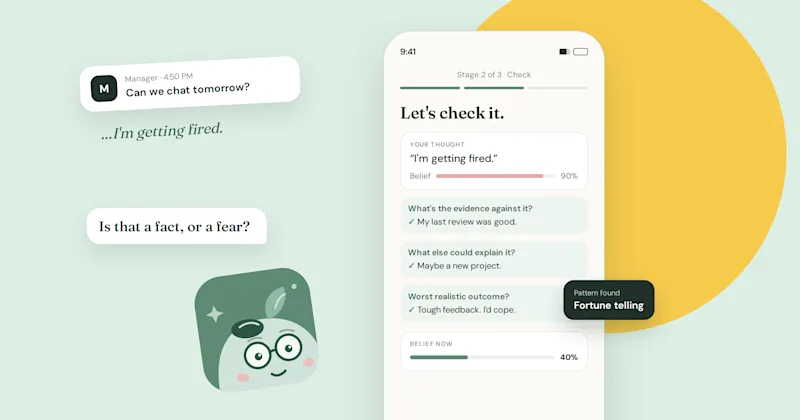
Socratic Questioning in CBT: 7 Questions to Ask Yourself
Your boss texts "can we chat tomorrow?" and your brain says you're fired. Here are 7 calm questions that help you check a thought before you believe it.

How to do a thought record in three minutes
The thought record is the core CBT exercise. This is the three-stage version MiraNote uses, with an example you can copy.
What is mind reading, and why does it feel so certain?
Mind reading is the habit of assuming you know what someone else thinks, without evidence. Here is how to spot it and what to write instead.