How to Stop Overthinking: 5 CBT Steps That Actually Help
Stuck replaying one thought on a loop? Here are 5 CBT steps to stop overthinking, plus a 3-minute exercise you can try tonight.
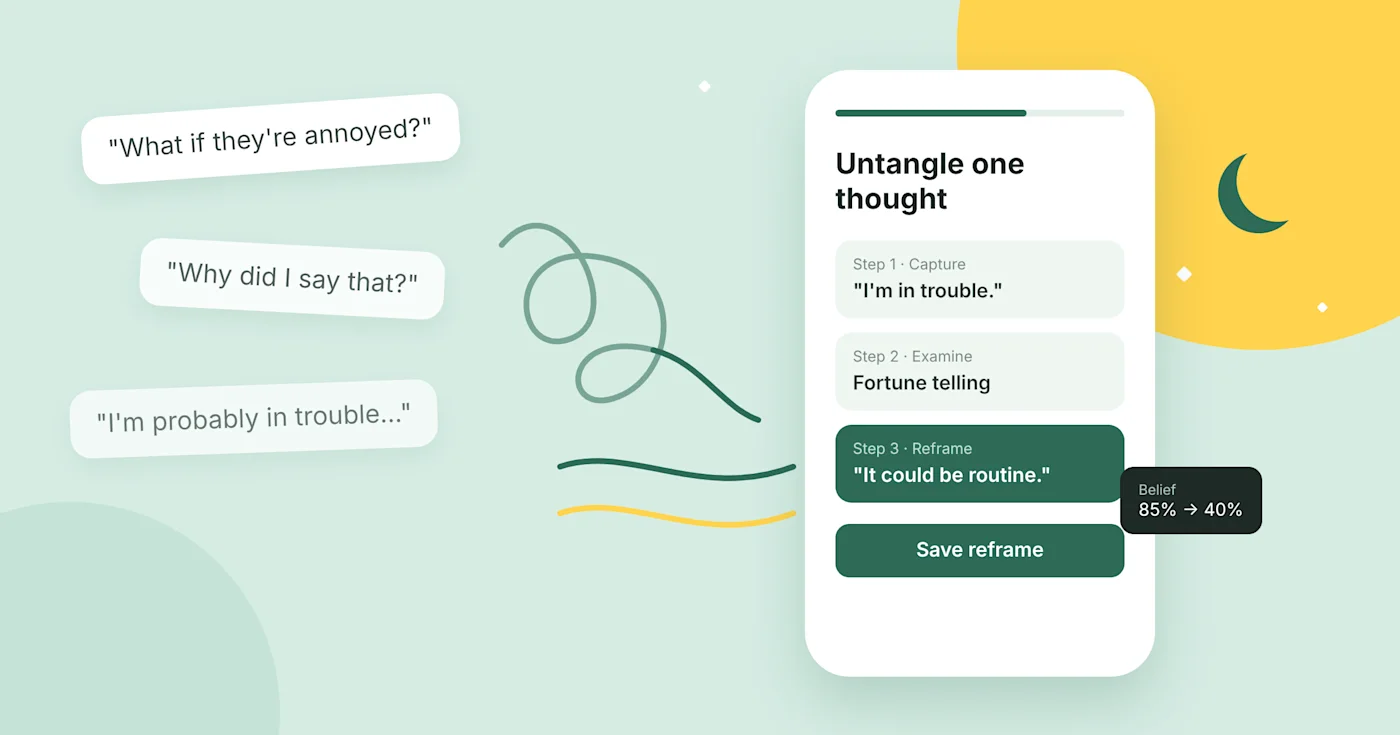
It's 11pm. You sent a message hours ago, and you've read it back six times. Maybe it sounded rude. Maybe they're annoyed. Maybe you should explain. Your body is in bed, but your brain is still at work.
That's overthinking. It feels like problem-solving, but it rarely solves anything. The good news: it's a habit, not a personality trait, and habits can be retrained. Here are five CBT-based steps that help, plus a 3-minute exercise you can try tonight.
What is overthinking, really?
Overthinking usually shows up in two forms:
Rumination: replaying the past. "Why did I say that? What's wrong with me?"
Worry: rehearsing the future. "What if it goes wrong? What if they say no?"
Both loop. Both feel urgent. And both are driven by thoughts that sound like facts but aren't. That's why cognitive behavioral therapy (CBT) works well here: instead of trying to stop thinking, you learn to check what you're thinking (NHS).
How to stop overthinking: 5 steps that actually help
1. Ask: "Am I solving, or spinning?"
Useful thinking ends in a next step. Overthinking goes in circles. If you've had the same thought three times without a new idea, you're spinning. Naming it ("I'm looping again") is often enough to loosen its grip a little.
2. Get the thought out of your head
Thoughts feel bigger in your head than on paper. Write down the exact sentence your mind keeps repeating, word for word. "She thinks I'm annoying" is much easier to examine than a vague cloud of dread. This is the first step of a thought record, the core CBT exercise (NHS Talking Therapies).
3. Spot the thinking trap
Most overthinking runs on a few predictable patterns, called cognitive distortions:
Mind reading: "They must think I'm incompetent."
Catastrophizing: "If this goes wrong, everything falls apart."
Fortune telling: "I just know it won't work out."
Overgeneralizing: "This always happens to me."
Once you can name the trap, the thought stops feeling like the whole truth. It becomes one possible story. (If reframing is new to you, start with our guide to cognitive reframing.)
4. Weigh the evidence, then write a fairer thought
Ask yourself: what actually supports this thought? What doesn't? What would I tell a friend who said this? (Need more questions? Try these 7 Socratic questions.)
Then write a balanced version. Not forced positivity, just something more accurate. "She hasn't replied yet. She's probably busy. If something's wrong, I can ask." Notice how much lighter that is to carry.
Want a guided way to do steps 2 to 4? That's exactly what MiraNote is built for. You write the thought, it helps you spot the pattern, and you finish with a kinder, more balanced version in about three minutes. Download on the App Store or get it on Google Play. It's free to try.
5. Give your worries a time slot
This one sounds strange, but it works for many people. Pick a 15-minute "worry window" each day. When a worry pops up outside it, jot it down and tell yourself, "Not now, later." When the window comes, many of those worries feel smaller, or have solved themselves. A 2024 randomized trial found that this kind of worry postponement reduced worry compared with a waitlist group (Clinical Psychology in Europe).
Try it now: a 3-minute reset for an overthinking spiral
Use a thought that's bothering you right now, or borrow this one.
The thought: "My manager said 'let's talk tomorrow.' I'm in trouble."
Capture it. Write the thought and rate how strongly you believe it: 85%.
Name the trap. Mind reading and fortune telling. You're guessing what she means and how it ends.
Check the evidence. She didn't sound upset. Managers schedule chats for all sorts of reasons. Your last review was fine.
Reframe. "I don't know what the chat is about yet. It could be routine. I'll find out tomorrow, and I can handle it either way."
Re-rate. How strongly do you believe the first thought now? Maybe 40%. That drop is the whole point.
That's a thought record. Doing it on paper works. Doing it in MiraNote is faster, and you can look back later and see which traps show up for you most often.
Why overthinking feels so hard to stop
Overthinking often feels responsible, like if you stop worrying, you'll miss something. But going over a problem again and again rarely leads to a better answer. It mostly leads to less sleep and more stress. Checking a thought, instead of obeying it, breaks that loop.
When to get extra support
Self-help tools like these are great for everyday overthinking, but they aren't therapy. If anxious or looping thoughts last for weeks, affect your sleep, work or relationships, or feel hard to manage, talk to a GP, doctor or licensed therapist.
If you ever feel unsafe or think you might act on thoughts of harming yourself, please contact emergency help right away. In the US you can call or text 988. In the UK, Samaritans are available on 116 123. Elsewhere, call your local emergency number.
Your next 3 minutes
You don't need to stop every thought. You just need to stop believing every thought straight away. Next time your mind starts spinning, catch one sentence, name the trap, and write a fairer version.
MiraNote makes that a habit, one short thought record at a time. Download MiraNote for iPhone or for Android and try it the next time a thought won't let go.
Questions about this
Why do I overthink everything?
Overthinking often starts as an attempt to stay safe or solve a problem. Your brain replays the past or rehearses the future because it feels useful. But when the same thought loops without leading to a next step, it stops helping. Stress, tiredness and uncertainty tend to make it worse.
Is overthinking a mental health condition?
No, overthinking on its own is not a diagnosis. Almost everyone does it sometimes. But constant worry or rumination can be part of anxiety or low mood. If it lasts for weeks or gets in the way of sleep, work or relationships, it is worth talking to a doctor or therapist.
How do I stop overthinking at night?
Get the thought out of your head before bed. Write down the exact worry, name the thinking trap behind it, and write one fairer version. If it still needs action, note one small next step for tomorrow. A short thought record like this tells your brain the thought has been handled for now.
Can an app help with overthinking?
Yes, an app can make CBT skills easier to practise in the moment. MiraNote walks you through a thought record in about three minutes: capture the thought, spot the pattern, and write a kinder, more balanced version. It is a self-help tool, not a replacement for therapy, and it is free to try on iPhone and Android.
Written by
Content writer
Emily Carter writes for MiraNote about everyday CBT skills, thinking traps, and calm, practical ways to untangle a hard thought.
Written and reviewed under our editorial guidelines.
More from the blog
All posts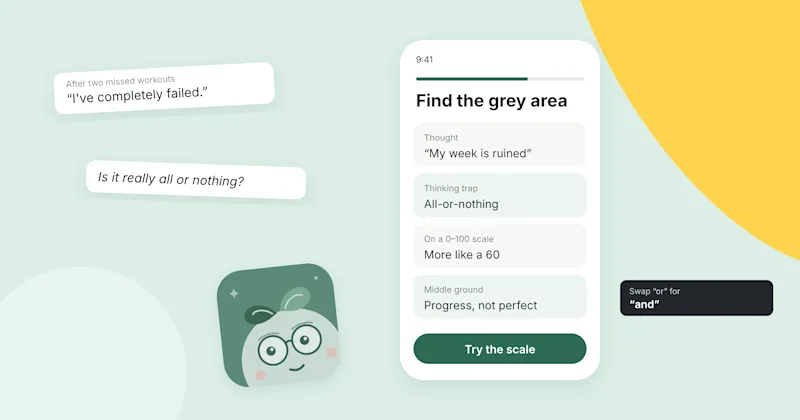
All-or-Nothing Thinking: Examples and How to Find the Middle Ground
One mistake doesn't mean you failed. See real all-or-nothing thinking examples, why your brain thinks in extremes, and 4 CBT steps to find the middle ground.
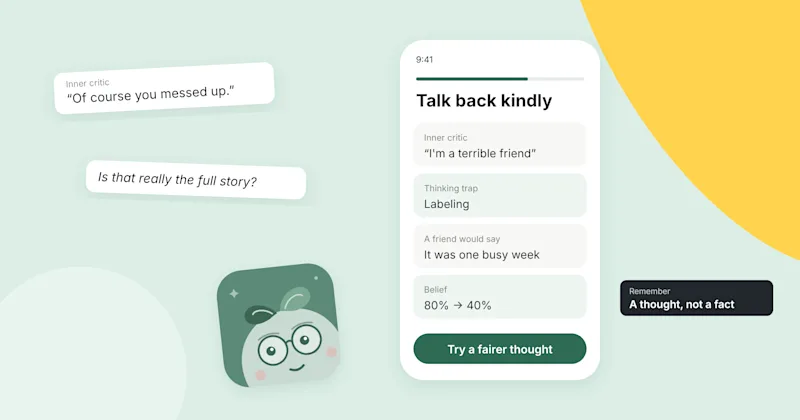
Negative Self-Talk: How to Quiet Your Inner Critic (Without Faking Positivity)
Your inner critic isn't telling the whole truth. Learn 5 CBT-based ways to quiet negative self-talk, plus a 5-minute reframe, no forced positivity needed.
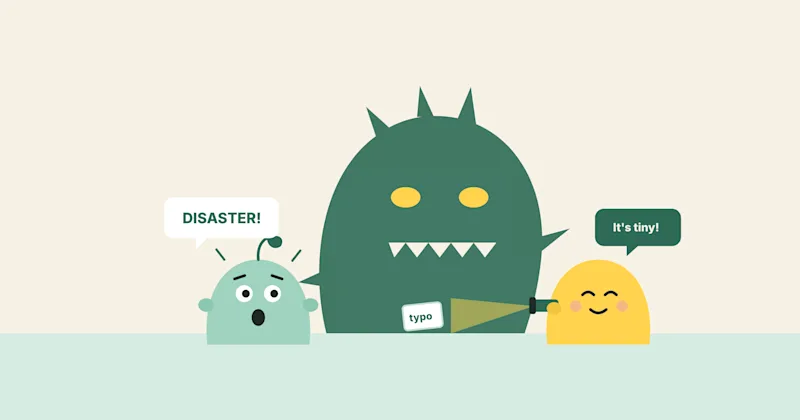
Catastrophizing: What It Is and How to Stop Expecting the Worst
Does your mind jump straight to the worst case? Learn what catastrophizing is, why it happens, and a simple 5-step CBT technique to stop it.