Socratic Questioning in CBT: 7 Questions to Ask Yourself
Your boss texts "can we chat tomorrow?" and your brain says you're fired. Here are 7 calm questions that help you check a thought before you believe it.
Socratic Questioning in CBT: 7 Questions That Talk Back to Anxious Thoughts
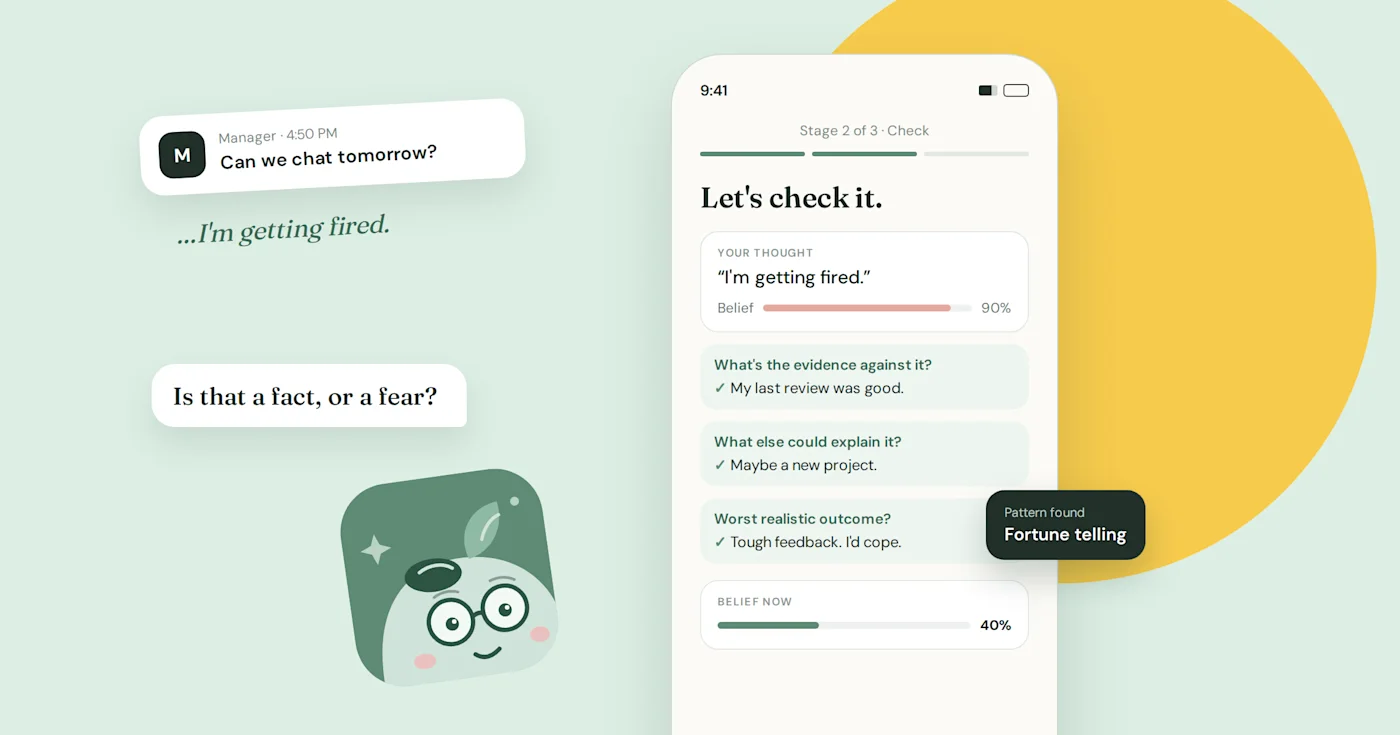
It's 4:50pm on a Thursday, and your manager sends a message: "Can we chat tomorrow?" There's no context. Within seconds, your brain has written the whole story, and you're getting fired.
You can't stop a thought like that by telling yourself to stop. But you can ask it a few questions.
Socratic questioning is a CBT technique where you ask calm, curious questions about a negative thought instead of arguing with it or believing it. The questions help you check the evidence, find other explanations, and land on a more balanced view yourself. Therapists use it constantly, and you can learn to do it alone.
What is Socratic questioning?
It's named after Socrates, who taught by asking questions rather than giving answers. In CBT, the same idea is called guided discovery. A therapist doesn't tell you your thought is wrong. They keep asking until you see it from a new angle. Psychologist Christine Padesky called it a cornerstone of CBT.
Why use questions instead of reassurance? Because "you're overthinking it" slides right off. A conclusion you reach yourself is the one that sticks.
Does it actually work?
Early evidence says yes. In a 2015 Ohio State study of 55 people in cognitive therapy for depression, sessions with more Socratic questioning were followed by bigger drops in symptoms.
That research looked at therapy, not self-help. Still, the goal of the technique is for people to learn to ask these questions themselves.
7 Socratic questions to ask a negative thought
Pick two or three. You don't need them all at once.
What's the evidence this is true?
Stick to facts only, the things a camera would record.
What's the evidence it isn't true, or isn't the whole story?
This is the one your mind wants to skip.
Am I treating a feeling as a fact?
Feeling like a failure isn't proof that you are one.
What else could explain this?
Find at least two other explanations.
What would I tell a friend who had this thought?
You're probably far kinder to them than to yourself.
What's the worst realistic outcome, and how would I cope?
Having a plan shrinks the fear. goes deeper on this one.
Is there a thinking trap here?
Thinking traps, also called cognitive distortions, are patterns minds slip into under stress.
Watch it work: "I'm getting fired"
Thought: "I'm getting fired." Belief: 90%. Anxiety: 8 out of 10.
Evidence for: The message was short. You missed a deadline two weeks ago.
Evidence against: The deadline was sorted out. Your last review was good. Your manager sends short messages to everyone.
Other explanations: It could be a new project, feedback on your report, or something they'd rather say in person.
Worst realistic outcome: Tough feedback. You'd listen and make a plan. It would be uncomfortable, and you'd survive it.
Balanced thought: "I don't know what this is about. It's probably routine, and if it's about the deadline, I can handle that conversation."
Belief now: 40%. Anxiety: 5 out of 10.
It isn't zero, and that's the point. You're not trying to feel great. You're trying to see clearly.
When the questions don't seem to work
Your mind keeps saying "yes, but…" Write the "but" down and question it next. Often it's the real worry hiding underneath.
The thought is partly true. Sometimes you really did make a mistake. Separate "I made a mistake" from "I ruin everything." The first one is fixable. The second one is a thinking trap.
It feels like an interrogation. Be a curious friend, not a prosecutor. "What else might be going on?" works far better than "Prove it."
Try it now: the 3-question check
This takes about five minutes.
Write the thought down exactly as it sounds in your head.
Rate how much you believe it, from 0 to 100%.
Answer questions 2, 4 and 6 in one sentence each.
Write one balanced sentence.
Re-rate your belief.
If the number dropped at all, it worked. Writing matters here. In your head, questions loop. On paper, you see the evidence side by side, which is exactly what a Record a thought is for. That balanced sentence at the end is a reframe, and you can learn more about building one in Click here.
If you'd like a guided way to practice this, Miranote walks you through each step. It helps you catch the thought, spot the thinking trap, and write a kinder, truer version.
When to get extra support
Socratic questioning is a self-help skill, not a replacement for professional care. If negative thoughts keep coming back, or they're affecting your sleep, work or relationships, a doctor or licensed CBT therapist can help.
If you're in crisis or thinking about harming yourself, contact your local emergency number. You can also call or text 988 in the US, or call Samaritans on 116 123 in the UK.
One last thing
Your mind isn't your enemy. It's trying to protect you, just a little too loudly. One honest question, asked kindly, is often enough to turn the volume down. Miranote is there whenever you want company while you practice.
Questions about this
What is a thought record?
A thought record is a short CBT exercise. You write down a situation, the automatic thought it triggered, and how strongly you felt it. Then you look at the evidence and write a more balanced version. In MiraNote this takes three stages and about three minutes.
Written by
Editors
Writing about cognitive distortions, thought records, and the everyday practice of examining a thought before believing it.
Written and reviewed under our editorial guidelines.
More from the blog
All posts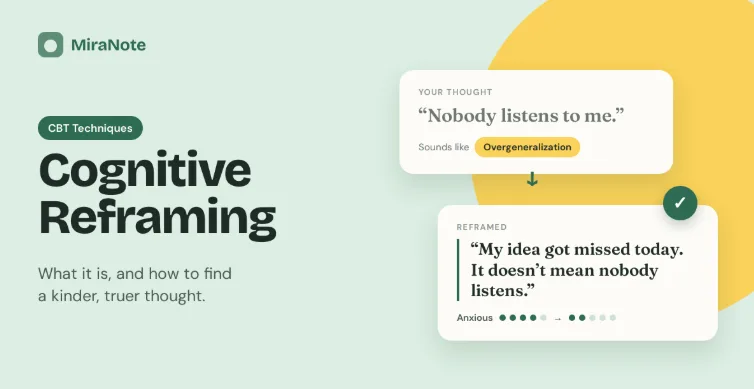
Cognitive Reframing: What It Is and How to Do It
A harsh thought isn't always the whole story. Learn how cognitive reframing works, with 5 simple steps, real examples, and a 5-minute exercise.
How to do a thought record in three minutes
The thought record is the core CBT exercise. This is the three-stage version MiraNote uses, with an example you can copy.
What is mind reading, and why does it feel so certain?
Mind reading is the habit of assuming you know what someone else thinks, without evidence. Here is how to spot it and what to write instead.